
Ask a room of coffee people which varieties they would drop everything to taste, and Sudan Rume comes up quickly. Ask how many have one at home, and the room goes quiet.
That gap is the story. It is one of the most wanted coffees in the world and one of the least available, and the reason for both is the same: this is a genuinely wild plant, and it has never behaved like a crop.
A wild coffee, and where the name comes from
Almost all the arabica in the world descends from a very small number of cultivated plants. Wild arabica, coffee that grew and adapted on its own, without anyone selecting it, survives in only a few places.
One of them is the Boma Plateau, in what is now South Sudan, about eighty kilometers from the Ethiopian forests. In December 1941 the botanist A. S. Thomas travelled there and collected seed from wild coffee growing on the slopes of Nelichu, in two valleys called Barbuk and Rume. The variety carries the name of the second one. Rume is not a person or a description. It is a place, and the coffee is named for exactly where it was found.
That collection turned out to matter well beyond one variety. Genetic work published in 2021 confirmed South Sudan as a center of origin for arabica in its own right, alongside Ethiopia, meaning the coffee Thomas found was not a stray planting but part of an original wild population.
What that wildness gives the cup
This is where the history becomes useful rather than decorative.
Most of the varieties in a café descend from a narrow slice of arabica's genetics, selected over centuries for yield, size and consistency. Sudan Rume comes from outside that slice. It carries a set of aromatic and structural traits that generations of farm selection never had the chance to smooth away, and that genetic breadth is what produces the complexity people describe when they talk about this coffee.
Which means the intensity in the cup is not a processing trick. It is the plant.
The moment the world met it
For most of the last century, Sudan Rume lived in research collections and a handful of specialist farms.
That changed in 2015, when Sasa Sestic won the World Barista Championship in Seattle using a carbonic maceration-processed Sudan Rume from Colombia. It introduced the variety to an audience that had never encountered it, and it put a name to a quality that competition judges had responded to without knowing what they were tasting. Since then, it has stayed on the competition stage, and interest in it has kept growing.
The gift almost nobody notices
Here is the part that makes this variety genuinely unusual.
Breeders recognized very early that Sudan Rume carried strong resistance to coffee berry disease along with exceptional cup quality, a combination that is rare, and valuable enough to build programs around.
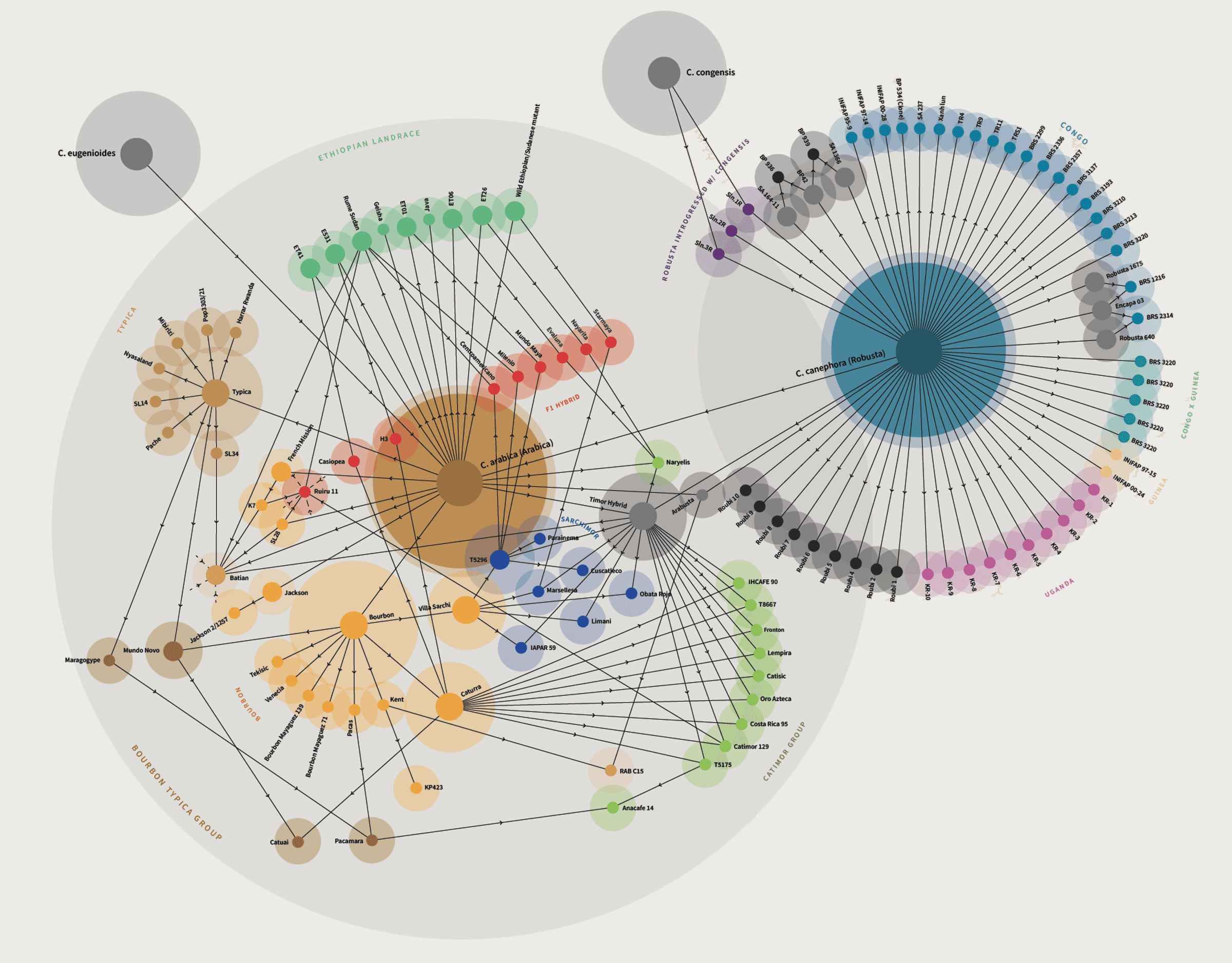
In Kenya, it became one of the parents of Ruiru 11, the compact, high-yielding variety released to give farmers protection against both coffee berry disease and leaf rust. Its resistance side came from Rume Sudan together with Timor Hybrid lines and K7; its cup quality came from N39, SL28, SL34 and Bourbon. It is also written into Batian, the Kenyan composite variety released in 2010, whose parentage runs through SL28, SL34, Rume Sudan, N39, K7, SL4 and the Timor Hybrid.
In Central America it became a parent of Centroamericano, a first-generation hybrid crossed with the rust-resistant line T5296 and released to farmers in 2010. In breeding evaluations Centroamericano produced 22 to 47 percent more coffee than the standard varieties of the region while holding exceptional cup quality at altitude. Milenio comes from the same cross.
Which means a wild plant from a South Sudanese hillside is now helping farmers across two continents grow more coffee, and better coffee, on land where disease used to decide the harvest. Very few varieties have given the industry that much.
What it tastes like
Sudan Rume has the refinement people associate with the great Ethiopian landraces, carried by a lively, complex acidity and a high level of sweetness. The aromatics are powerfully floral, opening with distinct notes of jasmine, rose, and hibiscus. Behind that floral lift sits a wide, vibrant fruit spectrum dominated by raspberry, red grape, and blackberry.
What makes this specific lot so special is its tactile structure. Supported by a sweet, malic, wine-like acidity, the sweetness presents beautifully like berry jam, honey, and gummy candy. The mouthfeel is syrupy and velvety, extending into a long, floral-fruit finish that lingers on the palate. Ultimately, our lot lands on the deeper, sweeter side of the Sudan Rume spectrum: a rich red fruit sweetness with a wine-like edge, and those signature florals lifting through the middle.
Why so little of it reaches a jar
Sudan Rume gives a small harvest. A farm that plants it is choosing quality over volume in the most direct way available, and committing several years to that choice before the first real crop arrives. It also asks for close attention, the right altitude, the right management, and picking that keeps pace with fruit that does not all ripen at once.
Which means the farms growing it are specialists, the lots are small, and each one is selected rather than simply produced. When a Sudan Rume appears, it is because a specific farm decided the ground was worth it.
What happens after picking
The variety sets the potential. What happens to the fruit in the days after harvest decides how much of that potential arrives in the cup. For our lot, that journey relies on an intentional, carefully managed Black Honey process designed to amplify the plant’s floral and wine-like character while maintaining absolute clarity.
It begins with selective harvesting, picking only deeply ripe cherries at their peak sugar concentration. These cherries undergo rigorous density sorting through flotation and hand-picking to ensure only the most flawless fruit continues. Instead of heading straight to the pulper, the whole cherries rest in sealed tanks for about 36 hours. This controlled pre-fermentation kicks off the enzymatic activity that builds the coffee's gummy candy-like texture, one of the defining sensory experiences of this lot.
When it is time to depulp, most of the mucilage is left clinging to the seed, creating the sticky, sugar-rich environment characteristic of Black Honey processing. From there, the coffee dries slowly on raised beds for nearly 18 days, with carefully managed airflow and temperature, before resting in parchment to stabilize. This meticulous approach preserves the intense sweetness and fruit complexity, highlighting notes of berry compote and floral saturation, without sacrificing the structural clarity that makes Sudan Rume so remarkable.
Our lot
Cauca has become one of Colombia’s most exciting coffee-producing regions, defined by its dramatic elevation shifts, volcanic influence, and cool mountain climate. Our lot comes from Julian Holguín Ramos, who farms on steep mountain terrain where cold nighttime temperatures deliberately slow cherry maturation. This extended time on the branch increases sugar concentration within the fruit, contributing directly to the coffee’s layered sweetness and vibrant acidity.
Julian’s approach marries this exceptional terroir with rigorous harvesting practices, focusing on high-Brix cherry picking, density separation, controlled flotation, and slow drying stabilization. Surrounded by a microclimate that combines volcanic soil with high organic matter, the farm produces coffees that offer both brightness and incredible depth, rather than just a sharp acidity. The result is a vivid, polished expression of what this land can do.
How we roast it
A coffee like this rewards a considered approach in the roaster, and it is one of the more satisfying profiles to build. Our overarching philosophy for this lot was transparency and elegance: preserving the volatile floral compounds while building just enough internal development to create depth and tactile sweetness.
Rather than pushing heavy caramelization, we focused on low-aggression heat application, an extended Maillard phase, and very restrained post-crack development to ensure aromatic clarity remains front and center.
The resulting profile highlights a beautiful floral lift, a wine-like structure, juicy sweetness, and a deeply layered finish. It is a profile built by tasting rather than by formula.
Drinking it
Brew it as filter to fully appreciate its clarity. With its syrupy body and vibrant notes of berry jam and jasmine, this is a coffee that presents several distinct characters in a single cup, and following those layered floral and dark fruit notes is half the pleasure.
Finding one
Sudan Rume arrives in small quantities and moves quickly. When we have one in the roastery, it appears here.